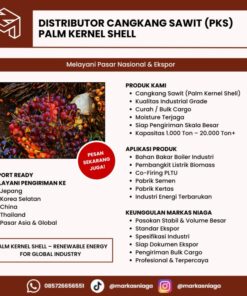

Palm Kernel Shell Supplier Indonesia for Industrial Boilers and Biomass Energy
Indonesian Palm Kernel Shell (PKS) Sourcing for Industrial Boilers, Biomass Power Plants, and International B2B Buyers
Are you looking for a reliable palm kernel shell supplier Indonesia sourcing partner for industrial energy production, biomass power generation, or bulk fuel procurement?
Markas Niaga connects international buyers with potential Indonesian palm kernel shell (PKS) suppliers, helping procurement teams identify suitable biomass fuel sources, evaluate technical specifications, and coordinate commercial inquiries.
Indonesia’s extensive palm oil processing industry produces palm kernel shells that can be utilized as solid biomass fuel for industrial combustion systems.
Whether you require screened PKS, non-screened palm kernel shells, or biomass fuel with specific calorific values, we can help coordinate sourcing discussions based on your technical requirements, purchasing volume, and preferred delivery terms.
PALM KERNEL SHELL SOURCING SERVICES
- Indonesian PKS sourcing for domestic and international buyers
- Screened and non-screened palm kernel shell inquiries
- Industrial boiler and biomass power plant applications
- Gross Calorific Value (GCV) and Net Calorific Value (NCV) requirements
- Moisture, ash content, and foreign material evaluation
- Bulk purchase and barge-loading arrangements
- FOB shipment inquiries and export logistics coordination
- Supplier documentation and certification verification
Request a Palm Kernel Shell Quotation
Website: https://www.markasniaga.com/
WhatsApp: +62 857-2665-6551
1. What Is Palm Kernel Shell (PKS)?
Palm Kernel Shell (PKS) is a solid biomass residue generated during palm oil processing.
After palm kernels are separated from their hard shells, the remaining shell material can be collected and utilized as fuel for industrial energy applications.
Palm kernel shells are recognized for their relatively high energy density, practical handling characteristics, and suitability for selected biomass combustion systems.
PKS is commonly used as an alternative or supplementary fuel in industrial boilers and biomass energy facilities.
Its suitability depends on technical characteristics such as calorific value, moisture content, ash percentage, particle size, and the design of the combustion equipment.
Why Industrial Buyers Consider Indonesian PKS
Indonesian palm kernel shells offer several potential procurement advantages:
- Access to biomass residues from a large palm oil processing industry
- Opportunities for bulk industrial fuel procurement
- Potential use in dedicated biomass boilers
- Compatibility with selected biomass co-firing systems
- Options for screened and non-screened material
- Availability of domestic and international commodity supply networks
Actual product quality, procurement feasibility, and shipment arrangements must be confirmed for each supplier and cargo.
2. Palm Kernel Shell Applications in Industrial Energy
Palm kernel shells are used in several industrial applications where solid biomass fuel is technically suitable.
A. Industrial Steam Boilers
PKS may be used as fuel in industrial steam boilers designed or adapted for appropriate solid biomass combustion.
Industries that may evaluate palm kernel shells include:
- Palm oil processing facilities
- Food and beverage manufacturing
- Textile processing
- Pulp and paper production
- Agricultural processing
- Industrial steam generation
Before purchasing PKS, boiler operators should review the fuel feeding system, grate configuration, combustion temperature, emissions controls, and ash-handling capacity.
B. Biomass Power Plants
Biomass power plants may use palm kernel shells to generate heat and electricity.
Key procurement considerations include:
- Consistent fuel calorific value
- Controlled moisture levels
- Acceptable ash content
- Stable particle size distribution
- Reliable fuel delivery schedules
- Sufficient storage and handling capacity
For long-term biomass power generation, stable fuel quality is particularly important.
C. Coal and Biomass Co-Firing
Palm kernel shells can be evaluated for co-firing alongside coal or other solid fuels in suitably configured combustion systems.
Co-firing feasibility depends on boiler technology, fuel preparation, feed-system compatibility, combustion behavior, ash chemistry, and environmental requirements.
Buyers should complete the necessary technical assessments before introducing PKS into an existing coal-fired system.
D. Industrial Thermal Processing
Some industrial facilities may consider palm kernel shells for thermal energy requirements, including selected cement and manufacturing processes.
The final decision should depend on plant-specific fuel acceptance criteria and operational performance.
3. Palm Kernel Shell Technical Specifications
Technical specifications are essential when evaluating PKS for industrial boilers or international biomass procurement.
The following values represent indicative market reference ranges only, not a guaranteed specification for material currently offered through Markas Niaga.
| Parameter | Indicative Market Reference |
|---|---|
| Product | Palm Kernel Shell (PKS) |
| Origin | Indonesia |
| Material | Palm kernel shell biomass residue |
| Gross Calorific Value (GCV) | Approximately 4,000–4,500 kcal/kg, depending on measurement basis and quality |
| Net Calorific Value (NCV) | Subject to actual laboratory analysis and moisture content |
| Total Moisture | Approximately 10–20% (as received) |
| Ash Content | Approximately 2–5%, depending on analysis basis |
| Particle Size | Depends on screened or non-screened grade |
| Foreign Materials | Subject to agreed buyer acceptance limits |
| Sulfur Content | To be confirmed by laboratory analysis |
| Packaging | Bulk, subject to loading arrangements |
| Certification | Subject to supplier and shipment verification |
| Inspection | As agreed between buyer and seller |
Important: A supplier’s Certificate of Analysis (COA), sampling method, test basis, and agreed contractual limits should determine the final acceptance criteria. Market reference values must not be treated as laboratory results for a specific shipment.
4. Gross Calorific Value (GCV) vs Net Calorific Value (NCV)
Calorific value is one of the most important technical parameters when purchasing palm kernel shell biomass fuel.
Gross Calorific Value (GCV)
Gross Calorific Value represents the total heat released during complete fuel combustion, including the heat associated with condensation of water vapor under the relevant test conditions.
GCV is often used as a headline parameter in biomass fuel specifications.
For industrial purchasing, buyers should clearly identify whether the reported GCV is measured on:
- As Received Basis (ARB)
- Air Dried Basis (ADB)
- Dry Basis (DB)
These values cannot be compared directly without accounting for differences in moisture basis.
Net Calorific Value (NCV)
Net Calorific Value represents the energy released excluding the latent heat of water vapor under the applicable calculation conditions.
NCV is particularly important when evaluating the usable energy potential of biomass fuels in operating equipment.
Moisture and hydrogen content influence the relationship between GCV and NCV.
Why GCV and NCV Matter to Buyers
Two palm kernel shell shipments may have similar gross calorific values on a dry basis but different net energy values on an as-received basis due to differences in moisture content.
Higher moisture generally reduces the usable energy delivered per metric ton of fuel.
For this reason, industrial buyers should specify the required calorific value, unit, reporting basis, and testing method in their RFQ.
Buyer Recommendation: Request both GCV and NCV on clearly identified bases whenever the information is needed to evaluate boiler performance and delivered energy costs.
5. Moisture Content and Its Impact on Biomass Fuel Performance
Moisture content has a direct influence on the combustion performance and commercial value of palm kernel shells.
Excess moisture can:
- Reduce net energy delivered per ton
- Increase the energy required to evaporate water
- Affect combustion stability
- Increase transportation costs per unit of usable energy
- Create storage and handling challenges
Palm kernel shell moisture can vary depending on the source, stockpile conditions, rainfall exposure, storage duration, and material handling.
What Buyers Should Specify
When preparing an RFQ, buyers should identify:
- Maximum allowable total moisture percentage
- As-received measurement basis
- Applicable laboratory testing method
- Sampling and inspection procedures
- Permitted tolerances and rejection criteria
Moisture acceptance limits should be agreed before shipment rather than assumed from general market references.
6. Ash Content and Industrial Boiler Efficiency
Ash content represents the non-combustible inorganic residue remaining after fuel combustion under specified laboratory conditions.
For industrial boiler operators, ash content matters because it affects:
- Ash collection and disposal
- Furnace and heat-transfer surface maintenance
- Boiler cleaning frequency
- Fuel handling operations
- Potential fouling and slagging behavior
However, ash percentage alone does not determine slagging risk. Ash composition, alkali content, ash melting behavior, and combustion conditions may also be important.
Buyers operating sensitive combustion equipment may request additional analysis of potassium, sodium, chlorine, and ash deformation characteristics.
PKS Quality Evaluation
A practical procurement assessment should consider calorific value, moisture, ash, foreign material, and the interaction of these properties with the intended boiler system.
Selecting PKS exclusively on price per metric ton may lead to higher effective energy costs if the delivered fuel has excessive moisture or unacceptable impurities.
7. Screened vs Non-Screened Palm Kernel Shell
Markas Niaga can facilitate inquiries for two common forms of palm kernel shell.
Screened Palm Kernel Shell
Screened PKS undergoes a screening process intended to improve the separation of shell material from fines, fibers, or other unwanted particles.
Potential advantages include:
- More controlled particle size distribution
- Reduced unwanted material when properly processed
- Improved suitability for certain fuel-feeding systems
- Easier matching with specified industrial requirements
Actual quality depends on screening performance, handling, storage, and verification results.
Non-Screened Palm Kernel Shell
Non-screened PKS is supplied without a dedicated screening step or with more limited material preparation.
It may contain a wider range of particle sizes, fibers, and other materials.
Non-screened PKS may be considered by buyers whose combustion systems can tolerate variable feedstock characteristics.
The final selection should depend on the buyer’s technical specifications and the available material.
8. Indonesian Palm Kernel Shell Supply for Bulk Buyers
Indonesia offers sourcing opportunities through palm oil producing regions, including Sumatra and Kalimantan.
Bulk PKS procurement commonly requires coordination between the original material source, stockpile operators, transport providers, loading facilities, and trading counterparties.
Markas Niaga assists buyers by facilitating relevant sourcing and commercial discussions.
Current Indicative Commercial Reference
The following information is based on a supplier offer communicated to Markas Niaga and is subject to reconfirmation before any transaction.
| Item | Commercial Reference |
|---|---|
| Non-Screened PKS | IDR 1,150/kg |
| Reported Non-Screened Stock | 5,000 MT |
| Non-Screened Delivery Basis | FOB barge, exact loading point to be confirmed |
| Screened PKS | IDR 1,450/kg |
| Screened PKS Location | Bengkulu, Indonesia |
| Screened PKS Delivery Basis | FOB Bengkulu, subject to named loading point |
| Screened PKS Certification | GGL certification reported; documentary verification required |
| Payment | To be confirmed in the formal sales terms |
Prices, quantities, quality, and loading availability may change.
The indicative prices above are not binding offers and should not be assumed to include international ocean freight, discharge costs, insurance, or destination-country charges.
For overseas buyers, quotation currency, shipment quantities, and any applicable export arrangements must be confirmed with the relevant contracting parties.
9. FOB Shipping and Bulk Biomass Logistics
Bulk palm kernel shell procurement requires careful coordination of cargo preparation and transportation.
Depending on the supply location, shipment arrangements may involve:
- Supplier and stockpile identification
- Preliminary quality assessment
- Sampling and laboratory testing
- Commercial quotation and contract negotiations
- Inland transport and stockpile handling
- Barge or vessel loading coordination
- Cargo weighing and inspection
- Preparation of the agreed shipping documentation
FOB Supply Arrangements
For international transactions, FOB terms should specify the named port of shipment and the applicable Incoterms version, such as Incoterms 2020.
Where a domestic offer is described as “FOB barge,” the contracting parties should clarify loading responsibilities, risk transfer, costs, and the precise loading point.
Barge-based supply terms should not automatically be assumed to include loading onto an international ocean-going vessel.
International Shipment Inquiries
International buyers may request quotations on a suitable FOB, CFR, or CIF basis where the supplier or export partner can support the relevant arrangement.
Shipping feasibility and commercial terms depend on cargo volume, loading infrastructure, freight availability, and contractual requirements.
10. Quality Inspection and Certificate of Analysis (COA)
Before placing a bulk PKS order, buyers should request appropriate quality documentation.
A Certificate of Analysis may include:
- Gross Calorific Value
- Net Calorific Value
- Total Moisture
- Ash Content
- Volatile Matter
- Fixed Carbon
- Total Sulfur
- Chlorine Content
- Particle Size Distribution
- Foreign Material Content
Not every transaction requires every parameter. The testing scope should reflect the buyer’s intended application and contractual requirements.
Where commercially appropriate, buyers may arrange independent sampling and inspection through a mutually accepted inspection provider.
Laboratory results should identify the sampled lot, reporting basis, analytical methods, and relevant testing dates.
Certification and Traceability
Some biomass buyers require sustainability or chain-of-custody certification, such as Green Gold Label (GGL).
Certification should only be accepted after checking the applicable certificate holder, scope, product coverage, validity, and relevant transaction documentation.
A general statement that a supplier is certified does not automatically establish that a particular shipment qualifies as certified material.
Markas Niaga can help coordinate requests for supporting documents from potential suppliers.
11. Why Work With Markas Niaga for Indonesian PKS Sourcing?
Markas Niaga provides B2B sourcing and commercial coordination services for buyers seeking Indonesian commodities and industrial products.
Our role is to help connect qualified purchasing inquiries with potentially suitable suppliers and transaction partners.
Our Sourcing Approach
Buyer Requirement Assessment
We collect relevant technical, commercial, volume, and delivery requirements before approaching potential suppliers.
Supplier Matching
We help identify potential PKS sources based on the requested product type, available information, and desired loading location.
Specification Coordination
We communicate buyer requirements for calorific value, moisture, ash, screening, and other technical parameters.
Commercial Communication
We help facilitate discussions concerning prices, volumes, delivery terms, inspection procedures, and documentation.
Transaction Coordination
Where agreed, we assist communication among the buyer, supplier, inspection company, and logistics partners.
Markas Niaga operates as a sourcing and trading intermediary. Product ownership, manufacturing, export responsibilities, and contractual obligations depend on the parties involved in the final transaction.
All product specifications, availability, certifications, and commercial offers remain subject to supplier confirmation and applicable agreements.
12. Request for Quotation (RFQ) – Indonesian Palm Kernel Shell
Are you sourcing palm kernel shell biomass fuel for an industrial boiler, power plant, or international commodity trading operation?
Please send your purchasing requirements to Markas Niaga.
Required RFQ Information
Buyer Information
Company Name:
Country:
Contact Person:
Business Email:
WhatsApp Number:
Product Requirements
Product: Palm Kernel Shell (PKS)
Grade: Screened / Non-Screened
Required Quantity (MT):
Trial Order Quantity (MT):
Monthly Contract Volume (MT):
Minimum GCV (kcal/kg):
Minimum NCV (kcal/kg or GJ/MT):
Calorific Value Reporting Basis:
Maximum Moisture (%):
Maximum Ash Content (%):
Maximum Foreign Material (%):
Required Particle Size:
Additional Specifications:
Certification Requirements:
Shipping and Commercial Requirements
Preferred Incoterms:
Named Loading Port or Destination Port:
Destination Country:
Target Delivery Schedule:
Inspection Requirements:
Payment Terms:
Additional Comments:
Submit Your PKS RFQ
MARKAS NIAGA – INDONESIAN B2B SOURCING & TRADING NETWORK
Website: https://www.markasniaga.com/
WhatsApp: +62 857-2665-6551
WhatsApp RFQ Link: https://wa.me/6285726656551
Please include your technical specifications and estimated order volume to support a more relevant supplier inquiry.
13. Frequently Asked Questions About Indonesian Palm Kernel Shell
What is palm kernel shell used for?
Palm kernel shell is used as solid biomass fuel in suitable industrial boilers, biomass power plants, thermal processing facilities, and selected co-firing systems.
Is palm kernel shell suitable for industrial boilers?
PKS can be suitable for boilers designed or adapted to handle its physical properties, combustion characteristics, and ash behavior. Compatibility should be assessed by the boiler operator or equipment specialist.
What is the typical calorific value of Indonesian PKS?
Indicative market references commonly discuss gross calorific values around 4,000–4,500 kcal/kg, although reported values depend on material quality and the testing basis. Actual cargo values should be verified through laboratory analysis.
What is the difference between GCV and NCV?
GCV includes the heat associated with water vapor condensation, while NCV excludes latent heat that is generally not recovered in conventional combustion applications. Both values must be compared using consistent reporting bases.
What is the acceptable moisture content for PKS?
The acceptable moisture content depends on the boiler system and purchase contract. Buyers should establish a measurable maximum total moisture limit before confirming an order.
Why is ash content important?
Ash affects the quantity of solid residue that must be handled after combustion. Ash chemistry and combustion conditions can also influence fouling, slagging, and equipment maintenance.
Can I buy screened palm kernel shell from Indonesia?
Screened PKS may be sourced through suitable Indonesian suppliers. Availability, processing quality, quantity, and supporting certification must be checked for the requested shipment.
Is GGL-certified PKS available?
Certain suppliers report access to GGL-certified palm kernel shells. Buyers should request and verify certificate details and relevant chain-of-custody or transaction documents before accepting certified status for a specific lot.
Can Markas Niaga arrange bulk PKS sourcing?
Markas Niaga can facilitate supplier matching, purchasing inquiries, technical communication, and commercial coordination. Final availability and transaction arrangements depend on the participating supplier and contracting parties.
Can international buyers request FOB quotations?
Yes. Buyers may submit FOB inquiries specifying the preferred Indonesian loading port. Quotations depend on supplier capability, export arrangements, quantity, and the applicable commercial terms.
14. Source Palm Kernel Shell from Indonesia with Markas Niaga
Finding the right Indonesian palm kernel shell source requires more than comparing prices.
For industrial and international buyers, successful procurement depends on matching fuel quality with operational requirements, confirming supplier capability, and coordinating the correct logistics arrangements.
Markas Niaga helps bridge communication between biomass fuel buyers and potential Indonesian suppliers.
Whether you require non-screened PKS for large-scale industrial fuel use or screened material with specific quality and certification requirements, we welcome detailed B2B procurement inquiries.
Looking for a Palm Kernel Shell Supplier in Indonesia?
Send us your RFQ with the required specifications, order quantity, and delivery destination.
MARKAS NIAGA
Connecting Buyers with Indonesian Supply Opportunities
Website: https://www.markasniaga.com/
WhatsApp: +62 857-2665-6551
REQUEST YOUR PALM KERNEL SHELL QUOTATION TODAY.